Monroe County is the Southernmost county in the state of Florida. Reaching from the Everglades to Key West, most of this large county is being affected negatively by invasive iguanas. Delicate ecosystems throughout these counties have seen the consequential damages created by iguanas because of their destructive habits and their behavior of affecting native wildlife. Some native species that are endangered have called the attention of local authorities and have contracted iguana control companies to tame the iguana infestations.
Invasive Iguana Species:
You will find three species of iguanas which are all non native to our region in Monroe County. The Green Iguana, Black Spiny Tail Iguana & The Mexican Spiny Tail Iguana which are all from Central and South America. Introduced to Florida in the 1960s through the pet trade, iguanas were bought as pets and purposely released into the wild when they became too big or became too much to handle. Since then iguanas have spread out infesting most parts of South Florida including Monroe County. Florida has very favorable environmental conditions which iguanas can thrive and reproduce in. Because of South Florida having many waterways such as canals, iguanas can easily travel from area to area causing further infestation. These waterways are breeding grounds for iguanas since they are undisturbed by humans. Along these canals you will find thousands of burrows that iguanas dig to lay eggs and to use as shelter from the very few predators that iguanas have.

Economic Consequences:
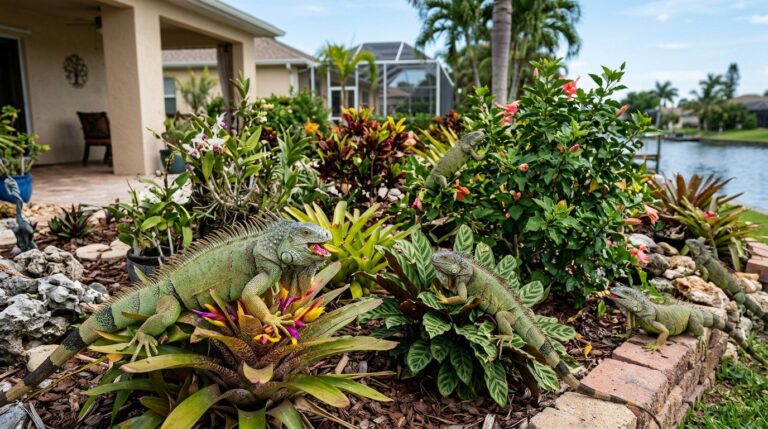
The economic impact that invasive iguanas have on our economy is one to be concerned about, this is because taxpayers are the ones who end up paying for the damages. Throughout Monroe County you will find beautiful landscaping, some of which are favored by iguanas such as Buganvilias, Hibiscus and seasonal flowers. These plants either get damaged or die because of iguanas voracious appetite for vegetation. Replacing these plants can become very costly since they are replaced continually. Damages to structures such as sidewalks, roads, seawalls and canals are caused by iguanas burrowing activity. When iguanas dig burrows, they continue to dig until the desired length is reached. These burrows can reach lengths of up to 70 ft with interconnecting tunnels. After some time, these burrows erode because of water runoff which jeopardizes the stability of the terrain and structures. These occurrences can happen in common areas and public areas such as parks. Liability to local municipalities also falls into play as these damages can cause bodily harm to humans and pets.
Potential Health Risks:
As stated by the National Institution Of Health (NIH), iguanas can spread a bacterium called salmonella which affects humans and pets. These bacteria can be mostly found in iguana feces which is why you should wash fecal matter properly in affected areas followed by proper sanitation. Iguana poop can be found in common areas such as parks, schools, and sidewalks all in which are high traffic of humans and pets. Parasites can also be found in and on iguanas such as ticks and mites. These parasites reproduce rapidly which can cause infestations & also pose health risks for humans and pets. As iguanas travel to various areas in the search of water and food, they can spread these parasites rapidly. Humans and pets are not the only ones affected, native species such as raccoons & opossums can also contract these parasites which can further spread these parasites.

Seminars To Educate The Public:
In learning about iguanas and their negative impact on our region, knowledge is power. Educating the public about iguanas and their impact on personal property is important. By knowing the signs of iguana infestations, local iguana control organizations can step in to eradicate these invasive species which can stop the spread of iguanas and their health risks. Here are a couple of signs that can tell you if you have iguanas on your property.
- Plant Damage: Iguanas will eat certain plants around your property, when they bite on leaves they will leave a particular “ V “ shape.
- Random Holes: During the months of January through April, you may find random holes around your property. This is a sign that iguanas are nesting to lay eggs. These holes will have a half circle shape which are actually burrows.
- Feces: Finding random droppings frequently in the same area is usually done by iguanas. Their feces can be identified because of its specific texture and size.
- Trails: Iguanas drag their tails as they travel, their tails will leave random line marks on dirt and sand.
- Skin Sheds: As iguanas grow, they shed their skin which you may find randomly around your property.
By following these signs, you can successfully identify if you have iguanas around your property.

Humane Iguana Control:
Controlling the iguana population is essential to avoid future infestations, damages and health risks. Our team of iguana removal experts are trained to locate and eradicate iguanas in many properties. By mitigating infestations early, you can stop the spread of iguanas on your property. Humane iguana removal methods are our priority as invasive species should be treated with respect and it is also the law. Being categorized as an invasive species by the (FWC) iguanas cannot be moved as this only spreads the infestation. If you would like to learn more about our iguana removal services in Monroe County, contact us!