
Raccoon Removal in South Florida
Humane removal, structural exclusion, and ongoing protection for residential and commercial properties across Miami-Dade, Broward, and Monroe Counties.
South Florida’s raccoon problem is not like the rest of the country’s. The climate, the architecture, and the density of the urban canopy create conditions that make raccoons both bolder and more destructive here than in almost any other market in the United States.
A family of raccoons that moves into an attic in Coral Gables or a ground-floor condo unit in Aventura is not passing through. They have found a resource — shelter, food proximity, or a climate-controlled environment — and they will remain until the access point is sealed and the attractant is removed. Trapping alone does not solve this. New animals occupy the same entry point within weeks if exclusion work is not completed alongside removal.
Wildlife Commander handles raccoon removal as a complete process: inspection, humane trapping, structural repair, and a monitoring plan that holds. Every job follows Florida Fish and Wildlife Conservation Commission guidelines.
The Damage Runs Deeper Than You Can See
The visible signs of a raccoon intrusion — overturned bins, disturbed landscaping, scratch marks on fascia — are the surface layer. The serious damage is inside.
Raccoons entering attics through soffit gaps, roof-edge separations, or deteriorating fascia boards cause four distinct categories of damage, each with its own repair cost.
Insulation contamination. Raccoons use a single area of the attic as a latrine. Feces and urine accumulate in the insulation, which must be removed and replaced entirely — not spot-treated. Contaminated insulation also carries Baylisascaris procyonis (raccoon roundworm), a pathogen that can remain viable in the environment for years.
Ductwork destruction. In South Florida specifically, raccoons are attracted to the cold air flowing through AC ducts. They tear into flexible ductwork to access the conditioned air, compromising the entire HVAC system and driving up energy costs well before the homeowner realizes what’s happening.
Electrical hazard. Raccoon incisor teeth chew through wire insulation continuously — the behavior is compulsive, not hunger-driven. Exposed wiring in an attic is a fire risk that standard home insurance inspections will not catch unless someone is specifically looking.
Structural water intrusion. Entry points torn through rooflines allow water infiltration during South Florida’s wet season. What starts as a biological problem becomes a structural one.
Wildlife Commander’s inspection process documents all four damage categories before any removal begins. The estimate covers the full scope — not just the trapping.
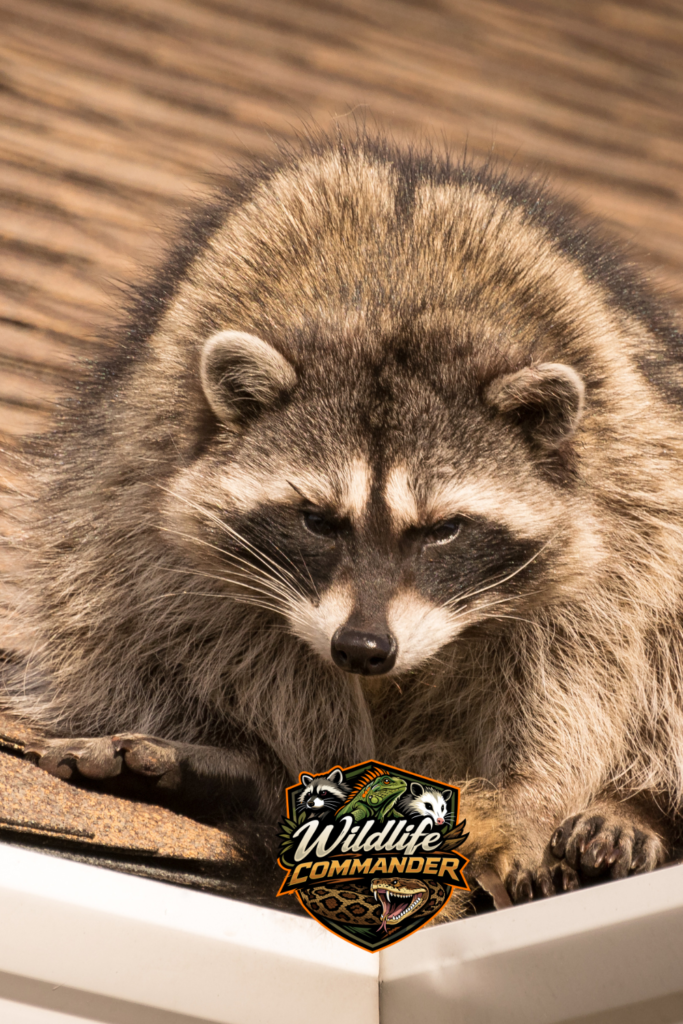
Activity Peaks When You'd Least Expect It
In most of the United States, raccoon activity slows in winter. In South Florida, the opposite is true. The six months between September and February represent the peak period for raccoon intrusions into structures.
There are two reasons. First, South Florida’s summer heat — sustained temperatures above 90°F through June, July, and August — makes attics uninhabitable even for animals adapted to the environment. Second, as temperatures drop into the comfortable 60s and 70s from October onward, attics become ideal denning sites at precisely the time of year when female raccoons begin selecting nesting locations ahead of spring birthing.
A female raccoon that establishes an attic as a denning site in November or December will give birth to a litter of three to five kits by March. By the time a homeowner hears movement in the ceiling, there is no longer a single animal to remove — there is a family, with a mother that will defend the space aggressively.
The practical implication: if you’re hearing sounds in your ceiling or noticing entry-point damage to your roofline, addressing it in the fall is significantly simpler and less expensive than addressing it in spring once a litter is present. Wildlife Commander operates year-round across South Florida and can assess your property before the season escalates.
Trapping Is the Beginning, Not the End
Florida law permits homeowners to trap raccoons on their own property without a permit. What it does not permit is relocating a trapped raccoon to another property, releasing it in a different county, or using poison under any circumstances. The legal release requirement — same contiguous property or humane euthanasia — reflects the FWC’s position on disease transmission vectors, particularly given that raccoons are a primary rabies host in Florida.
The practical result is that a homeowner who traps and releases on their own property has not removed the problem. The animal is removed from the trap. The entry point remains open. Another raccoon — or the same one — occupies the space within days.
Professional removal by Wildlife Commander means a licensed operator handles trapping under FWC authorization, exclusion work seals every identified entry point using materials raccoons cannot breach, and a follow-up inspection confirms the structure is secure. The full process — not the trapping in isolation — is what produces a lasting outcome.
Inspection to Resolution — What the Process Looks Like
Step 1 — Property Inspection
A Wildlife Commander technician inspects the full structure: roofline, soffits, fascia, vents, foundation, and any secondary structures on the property. Every potential entry point is identified and documented. Signs of current occupancy — tracks, feces, feeding evidence, scratch patterns — establish whether the intrusion is active. The inspection report forms the basis of the removal and exclusion proposal.
Step 2 — Humane Trapping
Live cage traps are set at identified access points and monitored on a schedule appropriate to the site. Every trap placement and removal follows FWC guidelines. No poison, no leg-hold traps, no methods that cause unnecessary suffering.
Step 3 — Structural Exclusion
Once the animals are removed, every confirmed entry point is sealed using wildlife-grade materials — galvanized steel mesh, hardware cloth, or structural fill, depending on the surface. Exclusion materials are selected for both effectiveness and appearance, particularly for visible rooflines on HOA properties and architectural facades in historic neighborhoods.
Step 4 — Sanitation and Damage Documentation
Contaminated insulation, feces deposits, and soiled materials are removed and disposed of in compliance with health guidelines. Damage documentation is provided for insurance purposes where applicable.
Step 5 — Monitoring and Follow-Up
Wildlife Commander offers ongoing monitoring plans for properties with recurring vulnerability — waterfront properties, wooded lots in Coconut Grove and Pinecrest, and multi-unit complexes where common-area access points create ongoing risk.
Raccoon Management for HOAs, Condo Associations, and Property Managers
South Florida’s density of condominium and HOA-governed communities creates a wildlife management challenge that residential operators are not equipped to handle at scale. A raccoon family denning in the common-area roof of a 200-unit condo complex in Aventura or a gated community in Weston is simultaneously a structural liability, a health code concern, and a resident relations issue.
Wildlife Commander works directly with HOA boards, property management companies, and commercial property managers to establish wildlife management programs that address current intrusions and prevent recurrence. This includes scheduled inspections of common-area structures, exclusion work on shared rooflines and utility corridors, and documentation suitable for board reporting and insurance filings.
The distinction between a residential call and a commercial program is the scope of accountability. Residential removal resolves an individual structure. A commercial program protects the asset, manages liability, and keeps the property management team ahead of complaints rather than behind them.
Marina and waterfront properties along Biscayne Bay and the Intracoastal present a related but distinct challenge — raccoons are highly competent swimmers and use docking structures, sea walls, and boat lifts as access routes to adjacent buildings. Wildlife Commander’s waterfront property assessments account for water-side entry points that standard inspections miss.
Raccoon Removal in South Florida — Frequently Asked Questions
Is raccoon removal legal in Florida without a permit?
Florida law allows homeowners to trap raccoons on their own property without an FWC permit. However, the trapped animal must be released on the same contiguous property or humanely euthanized — relocation to another property or county is not permitted. Professional wildlife operators hold FWC authorization to manage removal under a broader set of conditions and are responsible for compliance with all applicable regulations.
How do raccoons get into South Florida attics?
The most common entry points in South Florida homes are soffit separations, gaps in fascia boards, deteriorating roof-edge material, and unsealed plumbing or electrical penetrations. Tile roof systems are particularly vulnerable — the gaps between tiles and the roofline provide low-effort entry points that raccoons learn to exploit. Properties with overhanging tree canopy are at higher risk, as raccoons use tree limbs as access routes to rooflines.
What diseases do raccoons carry in South Florida?
Raccoons in South Florida are a documented rabies vector — Miami-Dade has confirmed rabies-positive raccoons in recent years. They also carry Baylisascaris procyonis (raccoon roundworm), Leptospirosis, and Salmonella. Contact with raccoon feces — including dried feces in attic insulation — carries genuine health risk and requires professional remediation, not standard cleaning.
How much does raccoon removal cost in South Florida?
Cost depends on the size of the intrusion, number of animals, extent of structural damage, and whether exclusion and sanitation work is required. Wildlife Commander provides free on-site estimates. The full-process cost — removal, exclusion, and sanitation — is consistently less than the cost of leaving a contaminated attic unaddressed, which typically requires full insulation replacement alongside repairs.
Can I just use repellents or deterrents instead of professional removal?
Commercial repellents and home deterrents do not work reliably on established raccoon intrusions. An animal that has selected a denning site has already assessed the space as safe and resource-rich. Repellents may temporarily displace the animal — they do not seal the entry point, address contamination, or prevent re-entry by the same or different animals. Exclusion work is the only method with a demonstrable long-term track record.
How long does raccoon removal take?
The trapping phase typically runs three to seven days depending on the number of animals and trap response. Exclusion work follows immediately once removal is confirmed and is completed in a single visit for most residential properties. Sanitation and insulation remediation is scheduled as a separate step. Wildlife Commander provides timeline estimates as part of the initial inspection report.
Does Wildlife Commander service the Florida Keys?
Yes. Wildlife Commander operates throughout Monroe County, including Key Largo, Islamorada, Marathon, and Key West. Waterfront and island properties present distinct wildlife access challenges that our inspection process is specifically designed to assess.
Raccoon Removal Across South Florida
Wildlife Commander provides raccoon removal, exclusion, and monitoring services throughout:


Call (305) 200-9821 or submit a free estimate request to schedule an inspection. ¡Hablamos Español!
A Raccoon Intrusion Doesn't Resolve on Its Own
The entry point stays open. The damage compounds. Schedule an inspection and get a complete assessment — removal, exclusion, and what it will take to protect the structure long-term.