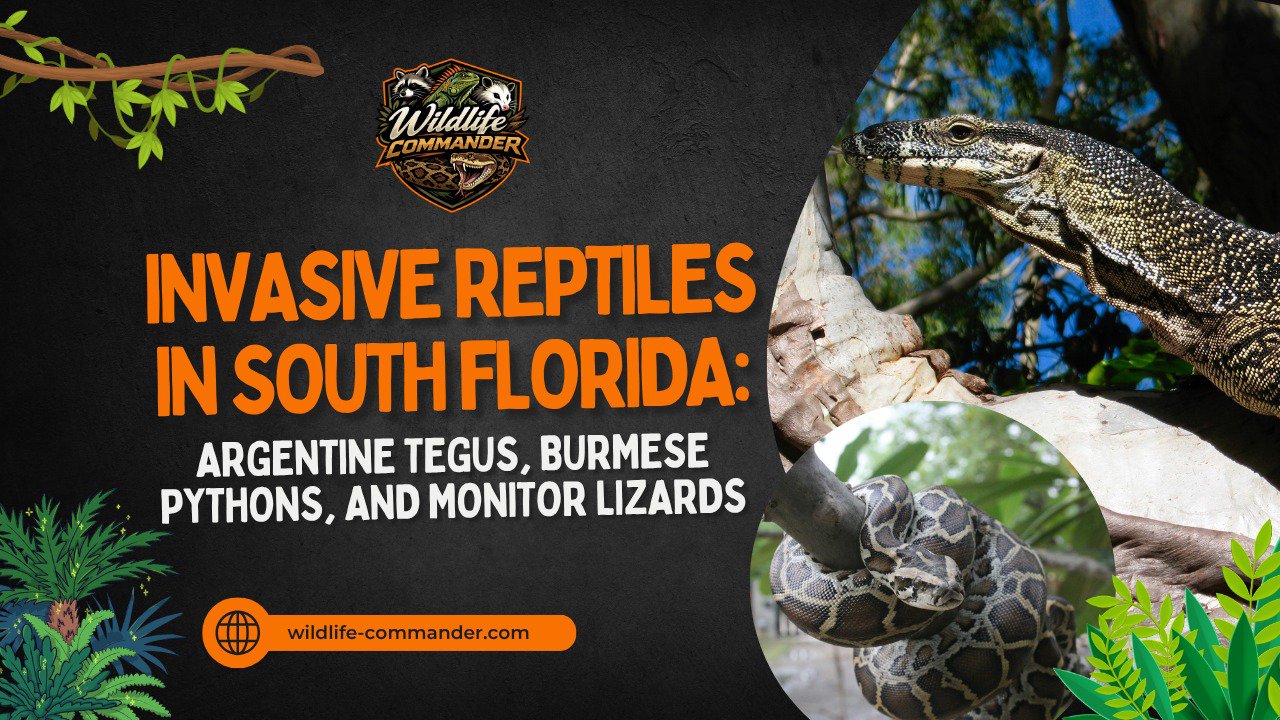
Invasive Reptiles in South Florida: Argentine Tegus, Burmese Pythons, and Monitor Lizards
South Florida's invasive reptile problem is no longer confined to the Everglades or to news articles about remote natural areas. Argentine black-and-white tegus are now documented breeding in residential neighbourhoods across Miami-Dade and Broward Counties. Nile monitor lizards have established populations along the Palm Beach and Lee County coast. Burmese pythons — long associated with the Everglades corridor — are moving into higher ground, and confirmed sightings now extend across Miami-Dade into urban and suburban zones.
These animals share one important characteristic: they are all Florida Fish and Wildlife Conservation Commission (FWC) Prohibited Species. That designation carries specific legal implications for property owners, HOA managers, and anyone who encounters one of these animals on their land.
Understanding the difference between these species — their behaviour, their risks, and the regulatory framework that governs their removal — is the starting point for an informed response.
Why South Florida is Ground Zero for Invasive Reptiles
Florida's climate, geography, and history as a centre of the exotic pet and animal trade created the conditions for the state's invasive reptile crisis. South Florida's subtropical climate — warm year-round, with minimal frost — allows cold-sensitive tropical species to establish self-sustaining populations. The proximity of developed residential land to natural corridors means that once a population establishes in a wild area, range expansion into suburban and urban settings is a predictable outcome, not an exception.
The FWC's response — including its Prohibited Species classification, expanded trapping programmes, and the 2025–2026 rule amendments addressing sale and caging — reflects the seriousness of the ecological threat. It also creates a legal context that property owners need to understand before attempting any response on their own.
Argentine Black-and-White Tegu (Salvator merianae)
What They Look Like
The Argentine black-and-white tegu is a large, heavily built lizard. Adults typically reach four to five feet in length and weigh six to fifteen pounds, with some males exceeding these ranges. The body is black with white or yellow banding. The head is broad and muscular, with a forked tongue and a noticeably powerful jaw structure.
Young tegus are vivid green on the head and upper body, transitioning to the adult black-and-white pattern as they mature. A hatchling tegu is roughly twelve inches long — easily mistaken for a different species in the field.
Where They Are Now
The established tegu range in South Florida now covers significant portions of Miami-Dade County, with confirmed populations in Broward and expanding pressure into Palm Beach. The species was first established in the wild through pet releases; it now reproduces at scale in Florida. A single female tegu lays between ten and thirty-five eggs per clutch. Hatchlings emerge in late summer. Population growth in established areas is fast.
Residential encounters are increasingly common. Tegus are ground-dwelling animals that forage widely — a single adult animal may move more than a mile from its core area. They are attracted to chicken coops, compost heaps, vegetable gardens, and garbage areas. They dig beneath structures (slabs, sheds, pool decks) and will enter open garages.
Risks to Pets, Wildlife, and Property
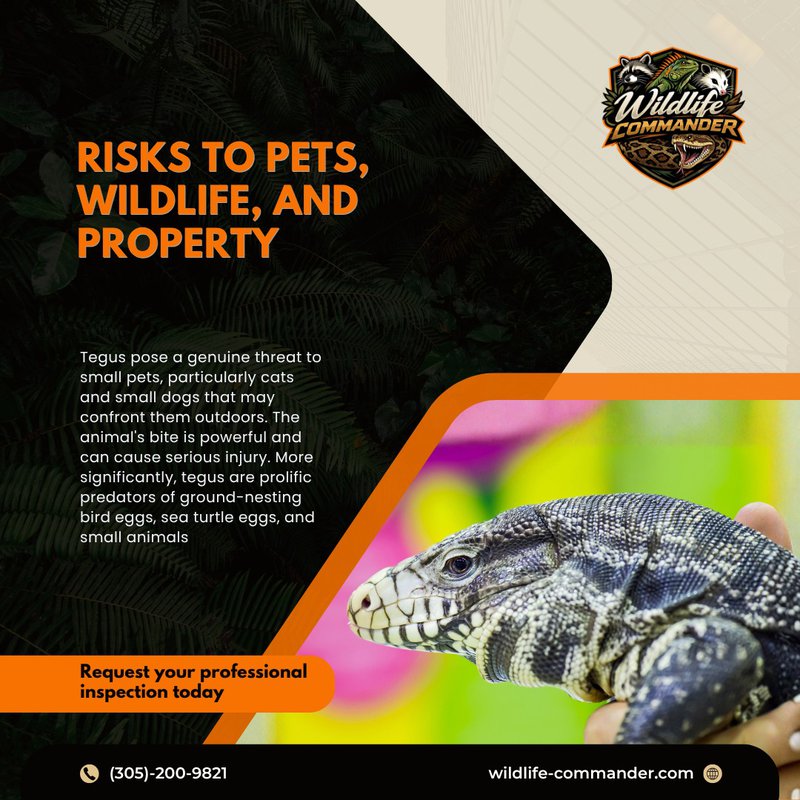
Tegus pose a genuine threat to small pets, particularly cats and small dogs that may confront them outdoors. The animal's bite is powerful and can cause serious injury. More significantly, tegus are prolific predators of ground-nesting bird eggs, sea turtle eggs, and small animals — making them a documented threat to native species, including protected sea turtles whose nests are commonly found on South Florida beaches.
For property owners, the main structural concern is burrowing behaviour. Tegus excavate substantial burrows and will expand existing voids beneath slabs, pool decks, and HVAC pad foundations. Active burrow systems beneath residential structures cause long-term ground stability issues.
Florida Law — What It Means for Property Owners
The Argentine tegu is a Prohibited Species under FWC rules. This designation means the animal cannot be possessed, sold, or transported. It also means that removal must result in humane euthanasia — relocation is not legal and not ecologically sound, as relocating a Prohibited Species animal simply moves the problem and may introduce the species to a new area.
Property owners who encounter a tegu on their land should not attempt to capture or restrain it without appropriate training and equipment. Licensed Florida Wildlife Control Officers handle removal and manage legal compliance, including reporting requirements.
Burmese Python (Python bivittatus)
What They Look Like
The Burmese python is among the largest snakes in the world. Adults in Florida commonly reach ten to sixteen feet in length, with confirmed individuals exceeding eighteen feet. Body colouration is tan or brown with darker brown blotches, often described as a pattern resembling puzzle pieces. The head is large and triangular relative to the neck.
Hatchlings emerge from eggs at approximately eighteen to twenty-four inches in length, with the same adult patterning.
Where They Are Now
Burmese pythons are established across the Everglades system and the southern tip of Florida. The range is expanding. Confirmed sightings outside the traditional Everglades corridor — including in agricultural areas in western Miami-Dade and Broward — indicate the population is not static.
The species is almost entirely nocturnal, making visual detection unreliable. Animals spend extended periods concealed in dense vegetation, under debris, and in drainage infrastructure. A property adjacent to a canal system, wetland edge, or conservation area in South Florida's western and southern zones has meaningful python exposure.
Risks
The ecological impact of Burmese pythons on South Florida's native wildlife is well-documented and severe. Populations of native mammals — rabbits, opossums, raccoons, foxes — have collapsed in areas with established python populations. The species is a generalist ambush predator that will consume animals up to the size of adult deer.
For property owners, the direct risk is primarily to pets — particularly dogs walked near canal banks or natural edges in the evening. The animal does not seek out human contact, but a large specimen that feels cornered or that mistakes a dog for prey represents a serious hazard.
Florida Law
The Burmese python is a Prohibited Species in Florida. It is also listed as an Injurious Wildlife species under federal law. There is no legal pathway for possession or relocation. Removal results in humane euthanasia by the licensed operator.
FWC operates a Python Elimination Program that compensates licensed contractors for pythons removed from designated areas. Wildlife Commander's removal process integrates FWC reporting requirements for this species.
Monitor Lizards: Nile Monitor and Black-Throated Monitor
What They Look Like
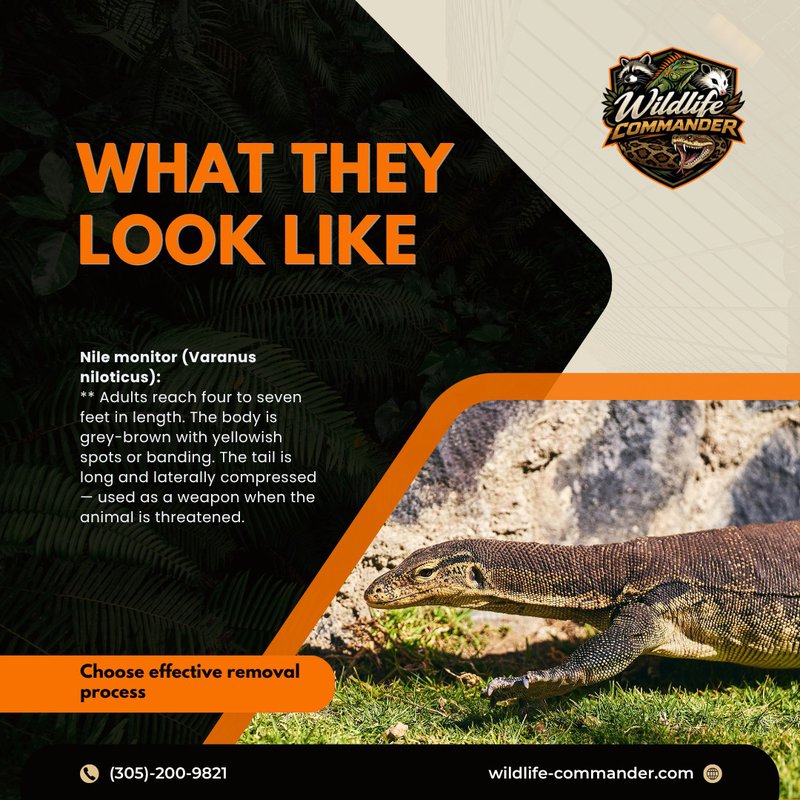
Two monitor species are established or expanding in South Florida:
Nile monitor (Varanus niloticus):** Adults reach four to seven feet in length. The body is grey-brown with yellowish spots or banding. The tail is long and laterally compressed — used as a weapon when the animal is threatened.
Black-throated monitor (Varanus albigularis microstictus):** Adults are heavy-bodied, typically four to five feet. Colouration is grey with white or yellow markings. Less widespread than the Nile monitor but documented in several South Florida counties.
Where They Are Now
Nile monitors have established populations in Palm Beach County and along Florida's west coast, with confirmed sightings expanding into Broward. Like tegus, they were introduced through the exotic pet trade. Unlike tegus, monitors are semi-aquatic and are frequently encountered near canals, retention ponds, and waterfront properties.
Risks
Nile monitors are aggressive when cornered and have powerful jaws, sharp claws, and a lashing tail capable of causing significant injury. Their canal and waterfront association makes them a regular encounter for South Florida marina operators, waterfront HOAs, and property management groups with retention pond maintenance responsibilities.
Monitor lizards also consume eggs and small animals and will investigate chicken coops, fish ponds, and any accessible food storage near water.
Florida Law
Both monitor species are listed as Prohibited Species. Removal follows the same legal framework as tegus and pythons — removal by a licensed operator, followed by humane euthanasia, with FWC reporting.
Why DIY Removal is Ineffective and Often Illegal
Attempting to capture or remove any Prohibited Species animal without a Florida wildlife control licence creates several problems simultaneously.
First, it is illegal. Possession of a Prohibited Species animal — even temporarily, even for the purpose of removing it from your property — violates FWC rules. The legal pathway for property owners who encounter these animals is to contact FWC directly (1-888-IVE-GOT1 / 1-888-483-4681) or engage a licensed operator.
Second, untrained capture attempts with tegus, monitors, or pythons carry meaningful injury risk. Tegus bite aggressively when restrained. Monitors scratch and thrash. Large pythons are physically powerful animals that require specific handling techniques to be safely managed.
Third, capture without proper exclusion does not resolve the underlying situation. Tegus and monitors have established home ranges. Another animal will move into an attractive site — structure with accessible voids, adjacent food or water source — shortly after removal if the site is not made uninhabitable.
Commercial and HOA Considerations
The transition of invasive reptiles from remote wild areas into suburban and urban settings creates specific responsibilities for property managers and HOA administrators.
Common area exposure: HOA communities with preserve buffers, retention ponds, or canal-edge common areas are the highest-risk residential settings for tegu and monitor activity. These common areas are responsibility areas — liability for an incident involving a resident and an invasive reptile on common ground sits with the property management entity.
Marina and waterfront commercial properties: Monitor lizard and python activity near waterfront commercial sites — particularly marinas with fish cleaning stations, bait storage, and dock storage — is an established pattern in affected counties. Seasonal monitoring of these areas is a straightforward mitigation step.
Municipal and institutional properties: Golf courses, parks, and municipal green spaces in southern Miami-Dade and Broward are now within documented tegu range. Grounds management protocols that address invasive reptile sightings — including staff training, a clear reporting chain, and a licensed removal partner — reduce response time and liability exposure.
Reporting and Professional Removal
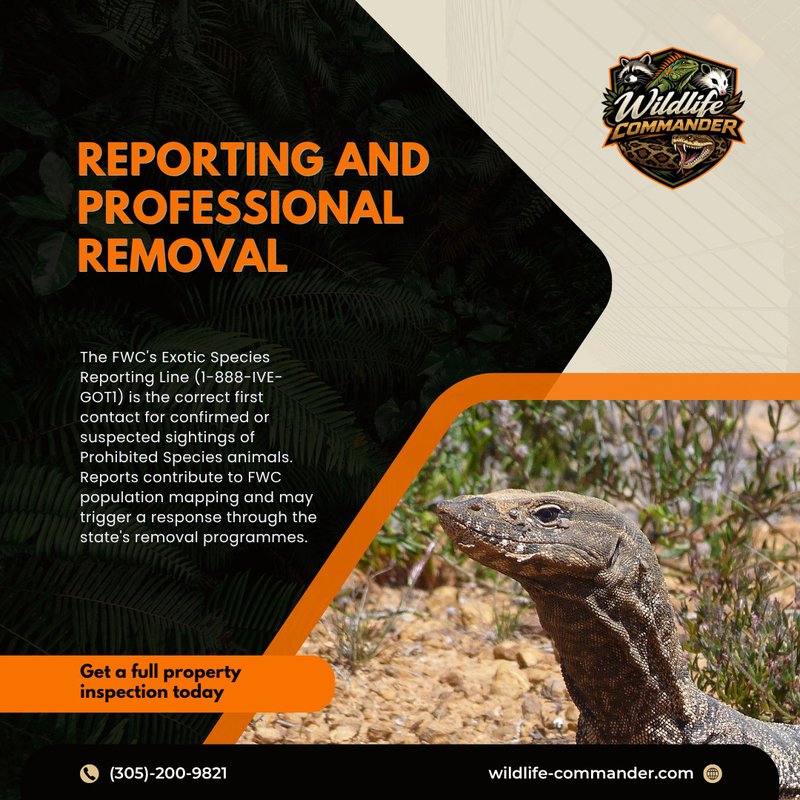
The FWC's Exotic Species Reporting Line (1-888-IVE-GOT1) is the correct first contact for confirmed or suspected sightings of Prohibited Species animals. Reports contribute to FWC population mapping and may trigger a response through the state's removal programmes.
For property owners dealing with confirmed, recurring, or structural-impact invasive reptile activity, engagement with a licensed Florida Wildlife Control Officer is the appropriate next step. The process follows the same inspection-led approach Wildlife Commander applies to all species: identify what is present, assess the site conditions contributing to activity, remove the animal using lawful and humane methods, and address site factors that make the property attractive to further activity.
Frequently Asked Questions
What invasive reptiles are established in South Florida?
The three primary species of concern are the Argentine black-and-white tegu, the Burmese python, and the Nile monitor lizard. All three are FWC Prohibited Species with established breeding populations in portions of South Florida. The black-throated monitor is a secondary concern with more limited distribution.
Is the Argentine tegu dangerous to pets?
Tegus are capable of injuring small to medium-sized dogs and cats, particularly if the animal is cornered or defending a burrow. The primary risks are bite injuries and, for female tegus with nests, defensive aggression. Tegus do not actively pursue pets but will respond forcefully to close contact.
Are Burmese pythons in Miami-Dade?
Yes. Burmese pythons are established across the Everglades system, which includes portions of Miami-Dade County. Confirmed sightings outside the traditional Everglades corridor — including agricultural and suburban interface zones — are documented and increasing.
What should I do if I see a tegu in my yard in Florida?
Do not attempt to capture or handle the animal. Report the sighting to FWC at 1-888-IVE-GOT1. If the animal is causing structural or safety issues on your property, contact a licensed Florida Wildlife Control Officer.
How do I report an invasive reptile in Florida?
Contact the FWC Exotic Species Reporting Line: 1-888-IVE-GOT1 (1-888-483-4681). You can also report online through the FWC's IveGot1 platform. Reports should include the location (as precise as possible), the species if identifiable, and any photographs if they can be taken safely from a distance.
Can invasive reptiles be relocated rather than euthanised?
No. FWC Prohibited Species designations prohibit transport and release. Any licensed removal results in humane euthanasia of the animal. This is an ecological requirement — relocated Prohibited Species animals extend the invasion problem to new areas and may establish new breeding populations.
The Response South Florida Properties Require
South Florida's invasive reptile situation is not static. The tegu's residential range expands with each breeding season. Monitor lizard populations near waterfront developments are documented and growing. The Burmese python, once primarily an Everglades concern, is now a consideration for any property adjacent to natural corridors in the southern part of the state.
The properties that manage this most effectively are those with a clear protocol: know what the species are, understand the legal framework, have a licensed removal partner, and conduct periodic site assessments rather than waiting for a crisis encounter.
Wildlife Commander provides licensed invasive reptile removal across Miami-Dade, Broward, Palm Beach, and Monroe Counties. If you have confirmed or suspected activity on your property — residential, HOA, or commercial — contact us for an inspection.
Wildlife Commander provides licensed wildlife removal services for invasive and native species across South Florida. All Prohibited Species removals are conducted in compliance with FWC regulations.
SEO Brief — For Editorial Reference
Target primary keywords: invasive reptile removal South Florida, Argentine tegu removal Florida
Secondary keywords: Burmese python removal Florida, monitor lizard removal Florida, FWC prohibited reptiles Florida, tegu control Miami-Dade
Long-tail targets: Argentine tegu in my yard Florida, what to do if you see a tegu in Florida, invasive reptile control HOA Florida
AI search intent targets: "What invasive reptiles are in South Florida?", "Is the Argentine tegu dangerous to pets?", "Are Burmese pythons in Miami-Dade?", "How do I report an invasive reptile in Florida?"
Internal link recommendations: Homepage, Iguana Removal (cognate species authority), Contact/Inspection CTA
External authority links: FWC Exotic Species Reporting (1-888-IVE-GOT1), FWC IveGot1 platform
Schema recommendations: FAQPage schema on FAQ section; Article schema with author/date for E-E-A-T signals
Estimated word count: ~2,300 words