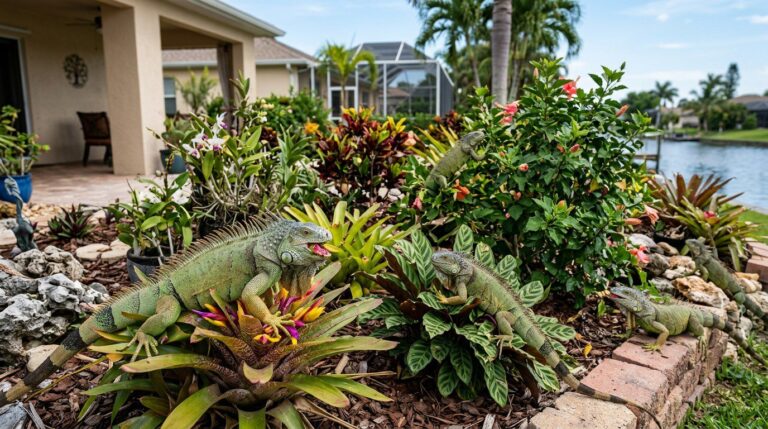

Visiting parks in South Florida to relax, exercise, play, or attend family gatherings is common for many South Floridians. But when these local parks are infested with iguanas it’s a recipe for disaster because of rapid breeding, damages and health risks. Many families that visit these parks find it super cool to see these big beautiful green & orange iguanas and it really is a fascinating experience! What is not so fascinating are the health risks and damages that these iguanas can pose to family friendly parks. Health risks and damages are only one major concern, and there are others. The constant breeding of these iguanas in local parks have caused major problems to local residents and businesses because of new infestations developing regularly. Once these baby iguanas hatch, they disperse to neighboring areas.
Ever heard of falling iguanas? This is a real occurrence during cold snaps in South Florida, iguanas are cold-blooded reptiles and they become immobilized and fall from trees when temperatures drop below 40°. The falling iguana phenomenon is genuine and a man doing yoga that was hit by a falling iguana can attest to this occurrence. By controlling iguanas in parks, we can reduce or eliminate the threat of infestations which impact local homes and businesses!
The Iguana Problem Get’s Worse!
These invasive iguanas have overtaken local parks which have caused concerns for residents. Roaming freely, iguanas constantly mate and breed throughout these parks. If you didn’t know, female iguanas can breed up to 70 iguanas in a year. Green Iguanas are not the only non-native species that are affecting parks, but The Black Spiny Tail Iguanas & Mexican Spiny Tail Iguanas have also been documented roaming through these beautiful parks.
During the summertime, iguanas are more active as it’s a warmer time of the year which they favor since they are cold-blooded reptiles. During the day iguanas will forage for food and sunbath in warm areas to regulate their body temperatures. While sunbathing, they are also pooping in common areas where family activities occur. This can cause illness to humans and pets because of salmonella transmission from coming in contact with their poop. Feeding iguanas in parks? We don’t recommend it! When iguanas are fed, they become accustomed to being hand fed. The issue with hand feeding is the possibility of being bitten by the iguana. They have razor-sharp teeth which could rip through flesh and can even transmit diseases.

Iguana Infestation To Your Home Or Business
As iguanas infest parks, they begin to breed & disperse which is the cause of infestations to neighboring properties. This is due to their noticeable proliferation, ten to seventy iguanas a year can become very problematic incredibly quickly. Once iguanas enter your property, they will look for three things! Water, food & shelter. If they have access to these three resources they will make your home or business their new home. Daily interactions with iguanas will be continuous as property owners try to make loud noises or spray iguanas with water to try to get them to leave. But as iguanas become familiar with these attempts, they will become accustomed to these attempts and will begin to ignore these scare tactics. Ever seen
5 to 6 iguanas lounging around your roof? It’s more common than you might think! If you have trees or bushes close to your roof line, iguanas will use this as a ladder to climb up and down. This happens due to iguanas needing the warmth of roof tiles to regulate their body temperature. If your roof stacks are not properly covered, you may even have a surprise guest in your toilet. These mishaps can be avoided by proper iguana deterring methods and blocking entry points. In theory, the only way to keep iguanas out of your property is by having them trapped and removed.
Damaging Impacts Due To Iguanas In Local Parks
Damages caused by iguanas are not cheap, in fact they can run in the high thousands and even in the millions as the city in West Palm beach saw because of a dam collapse caused by iguana burrowing. Plants are no exception. While iguanas live on your property, they will eat up certain plants which can be expensive to replace. If you’re an orchid enthusiast, having iguanas will be very upsetting, especially since some orchid species are very expensive. Just imagine caring for a rare variety of orchids that only bloom once a year only to not be able to enjoy the beauty of its flower because of a hungry iguana! As iguana grow on your property, they will begin to breed and cause further infestation. If you see baby iguanas around your property, you have just become infested with a family of iguanas. This can become extremely frustrating for homeowners and businesses because of the damages that iguanas can cause. Structural damages due to burrowing is the biggest problem. When iguanas dig burrows underground to lay their eggs, it causes the terrain to soften due to erosion, which can cause sidewalks, decks and driveways to crack. This can be a very expensive repair. And if you live by the water, your seawalls are also at risk. This is a much bigger expense.
Protecting your property should be your top priority and it could be achieved by prosper iguana control and iguana monitoring.

Sickness & Diseases Transmission
Ever hear of fish tank granuloma (mycobacterium marinum)? This is a possible infection caused by being bitten by an iguana. This is why we recommend not to handle iguanas if you find one in or around your property. Iguanas may also carry ticks which they spread throughout parks, your home and your business. Ticks may carry diseases such as Lyme disease, Rocky Mountain Spotted Fever & Anaplasmosis, to name a few. Being bitten by ticks may cause symptoms such as fever, headache, fatigue, and a characteristic skin rash. Another infestation? If you have ticks around yes! These parasites can lay up to 6,000 eggs at a time. Iguana poop can also become problematic as it can stain and contaminate areas where the poop is present. If you come into contact with their droppings, you may be ill because of salmonella poisoning. Swimming pools are considered a public restroom for iguanas because of the frequent occurrence of iguana poop in your pool. Contamination of swimming pool water is common when iguanas defecate in them, it’s important to clean and sanitize any areas affected by iguana poop.

Controlling The Iguana Infestation
Eradicating iguana infestations in local parks is possible if the proper iguana control measures are implemented. Removing iguanas from the park not only keeps visitors safe, but it also helps avoid new infestation from occurring, which can help stop neighboring communities being impacted. Iguana trapping is a great way to capture iguanas around the clock, especially if repeating traps are put into play.
These custom repeating traps we have created have the capability of catching dozens of iguanas at a time. Using a pole snare is a less aggressive technique we used to catch iguanas around playgrounds, fishing docks in parks, and dog parks within local parks. The pole snare we use extends to 20’ which gives us the upper hand of catching iguanas while keeping our distance to not scare them off. Burrow monitoring is the most important factor for controlling iguana infestations. As iguanas dig burrows during the breeding season, we continuously check these burrows for eggs.
Once we locate iguana eggs using our endoscopy camera, we remove and dispatch the eggs humanely. It’s essential to not cover burrows as this makes it difficult for you to locate iguana eggs. Plus, covering burrows will not stop iguanas from hatching. Proper filling of these burrows is detrimental to avoid the terrain from collapsing, which can cause bodily harm. If pellet rifles and trapping are not an option during the daytime, night time iguana removal comes into play and the results are phenomenal! Being diurnal, iguanas are easily located at night using Led Head strap on lights. We have been able to effectively remove thousands of iguanas at night and infestations have been eliminated. Once infestations are kept in check, iguana monitoring should be implemented to stop future infestation from occurring. We remove not only iguanas to keep parks, humans and pets safe! We remove iguanas to help our ecosystem and our native species.
If you’re ready to eliminate the threat of invasive iguanas in your local parks, contact us to learn more about our effective methods to stop iguana infestations from forming.