
Bird Removal and Exclusion in South Florida
Licensed identification, removal, and exclusion for protected and nonprotected bird species across residential, HOA, and commercial properties in Miami-Dade, Broward, Palm Beach, and Monroe Counties.
Bird control in South Florida is not one service. It is two, governed by two different legal frameworks, and most companies quoting “bird removal” will not tell you which one applies to the birds on your property.
Woodpeckers, vultures, ospreys, and wading birds nesting in your landscaping are federally protected under the Migratory Bird Treaty Act. You cannot remove, harm, or disturb an active nest without a federal permit, regardless of the damage being caused. Feral pigeons, European starlings, house sparrows, Muscovy ducks, and monk parakeets carry no such protection and can be removed or excluded directly, without federal permitting.
Wildlife Commander’s bird service starts with species identification, because the species determines the legal pathway before it determines the technique. Every job follows Florida Fish and Wildlife Conservation Commission guidelines and, where applicable, U.S. Fish and Wildlife Service permitting requirements.
This Is a Documented Infrastructure Cost, Not a Nuisance Complaint
Florida Power & Light’s own data makes the case in numbers most bird control conversations never reach. Between 2001 and 2006, FPL logged 198 monk parakeet-related power outages across South Florida in a single five-month stretch, with lost revenue and repair costs totaling roughly $245,000 for that period alone. The utility ultimately removed more than 3,100 nests from transmission and distribution equipment across Miami-Dade and Broward to bring the problem under control — a documented infrastructure cost driven by one invasive species building stick nests, some weighing hundreds of pounds, directly onto energized equipment.
Residential and commercial properties absorb a version of the same pattern at smaller scale. Guano from roosting birds is acidic and corrosive on contact with roofing membrane, HVAC housings, vehicle finishes, and pool screen enclosures, and the damage compounds with every season a roost site goes unaddressed. Woodpecker drilling into stucco, fascia board, and cedar siding creates entry points for secondary pests and water intrusion, and it recurs at the same structure year after year once a bird has established the location as a territory or drumming site. Black vulture roosts are documented in Florida to strip rubber roofing membrane, pool screen mesh, and windshield wiper seals — activity insurance carriers increasingly flag as a disclosed maintenance issue.
Bird activity in South Florida runs year-round, unlike the seasonal windows that govern raccoon or bat activity. The species causing the most expensive damage are frequently the ones a property owner is not legally permitted to simply remove.
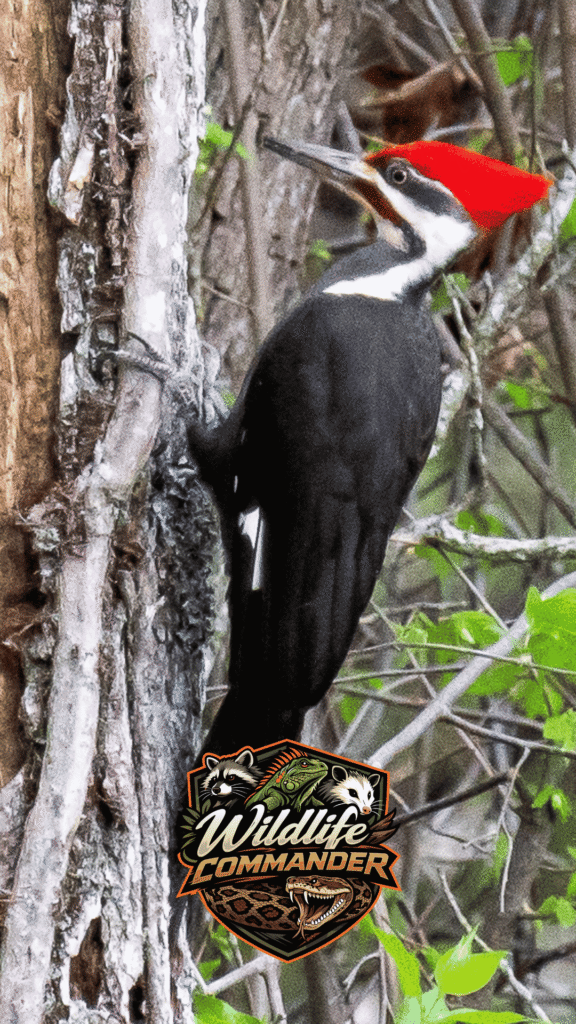
Federally Protected Birds — Exclusion Is the Only Legal Tool
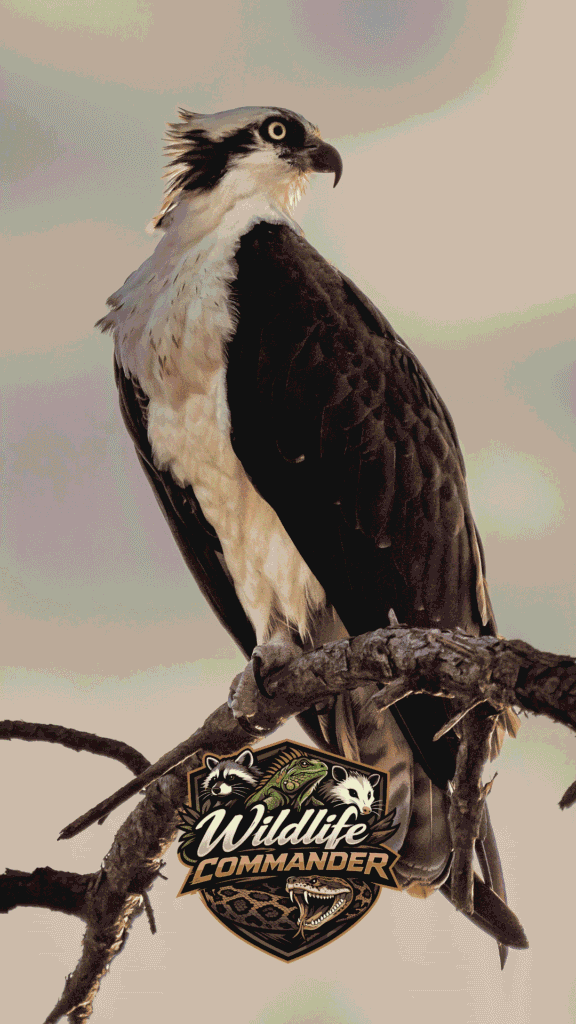
The Migratory Bird Treaty Act protects the great majority of native bird species found in South Florida, including every woodpecker species in the state, both black and turkey vultures, ospreys, and the wading birds common to South Florida landscaping and retention ponds — herons, egrets, ibis, and the boat-tailed grackle. Under the Act, it is illegal to kill, capture, harass, or disturb an active nest of any of these species without a federal permit issued by the U.S. Fish and Wildlife Service. This applies regardless of the damage being caused, and it applies equally to a homeowner, a licensed contractor, and an HOA board acting on a resident complaint.
Woodpeckers are the most common protected-species call Wildlife Commander receives. A red-bellied or pileated woodpecker drilling into a home’s fascia board is protected the moment it establishes an active nest cavity. Federal guidance is explicit: non-lethal deterrents — reflective tape, visual decoys, sound devices, and addressing the insect activity that often attracts the bird in the first place — must be attempted and demonstrated as ineffective before a depredation permit application has any basis. The permit itself, USFWS Form 3-200-13, requires documented justification, typically significant structural damage rising to an economic hardship, and is issued only after non-lethal methods have failed.
Black vultures follow the same legal structure with a different damage profile. Roost sites on commercial roofs, marina structures, and communication towers are addressed first through non-lethal harassment — effigies, distress calls, and physical deterrents that signal danger to the flock — with a federal depredation permit reserved for cases where harassment fails and damage continues. Ospreys nesting on light poles, cell equipment, and dock structures fall under the same framework and are a common call on South Florida marina and waterfront properties.
Wildlife Commander’s approach to protected-species bird pressure is exclusion-first: physical deterrents installed at the specific site driving the problem, designed to prevent nest establishment before it happens rather than respond to an active nest that already carries full federal protection.
Muscovy Ducks, Monk Parakeets, and Feral Birds — Removal Without a Federal Permit
Four species account for most of the bird activity Wildlife Commander removes directly, without federal permitting: feral rock pigeons, European starlings, house sparrows, and Muscovy ducks. None is native to North America, and the Migratory Bird Treaty Act’s protections apply only to native and naturally occurring migratory species — nonnative species introduced through human activity are excluded from coverage entirely.
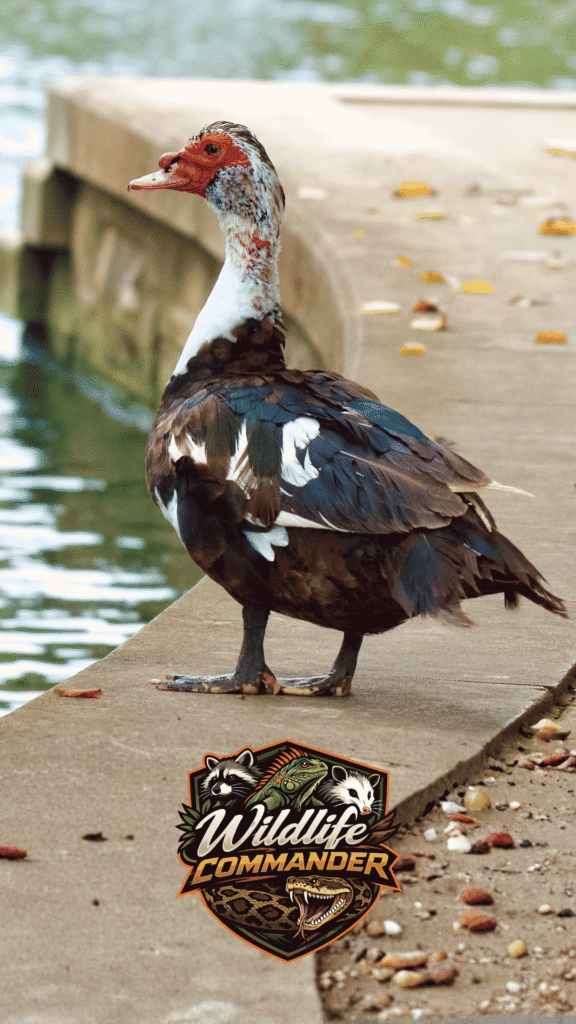
Muscovy ducks are the species South Florida property owners ask about most. Classified by the Florida Fish and Wildlife Conservation Commission as nonnative Class III wildlife, feral Muscovy ducks may be removed by a property owner or a hired nuisance wildlife operator without state or federal permit. The restriction that catches people off guard is relocation: nonnative wildlife in Florida cannot be captured and released elsewhere. Removed birds are handled humanely and are not relocated to a different property, a different neighborhood, or a canal down the road — that practice is itself illegal and simply moves the population problem onto someone else’s HOA.
Monk parakeets carry the same unprotected status and are the species behind the FPL infrastructure numbers cited above. Native to South America and established in South Florida through the pet trade, monk parakeets build large communal stick nests that expand year over year once established on a structure. Unlike most nesting birds, an active monk parakeet nest carries no federal protection and can be removed at the structure regardless of activity level.
Removal of any unprotected species still requires correct identification before work begins. A Muscovy duck and a native whistling duck look similar to an untrained eye at a distance, and the legal consequence of misidentifying a protected species as unprotected falls on whoever performed the removal.
Why Exclusion, Not Just Removal, Is the Actual Fix
Trapping or removing individual birds rarely solves a structural bird problem, because the site itself — the roofline gap, the covered dock structure, the pool screen enclosure — continues to attract new birds after the original occupants are gone. Wildlife Commander’s bird service is built around exclusion: physical modifications to the site that make it unusable as a perch, roost, or nest location, rather than a repeated response to whichever birds are currently occupying it.
Inspection and identification. Every job starts with species identification, because the species determines whether the work is a removal job, an exclusion-only job, or a federal permit process. The inspection also maps the specific structural features — ledges, gaps, canopies, eaves — driving the problem.
Exclusion installation. Exclusion spikes disrupt flat-ledge perching on parapets, signage, and architectural ledges. Netting systems close off covered structures — dock canopies, loading docks, parking garage levels. Monofilament line systems deter perching on rails and beams without the visual impact of netting or spikes, a consideration that matters on premium commercial and clubhouse architecture.
Removal where legally permitted. Unprotected species present on site are removed and, where applicable, humanely handled in compliance with Florida’s nonnative wildlife rules. Protected species are addressed through non-lethal deterrents first, with permit processes managed by Wildlife Commander when circumstances justify escalation.
Monitoring. A site assessment identifies which specific locations are driving the problem before any device is installed. Wildlife Commander’s monitoring program tracks re-establishment at cleared sites, because generic deterrent products installed without a proper assessment are a documented failure pattern — birds simply relocate to the next unprotected ledge.
Bird Management for HOAs, Marinas, Golf Courses, and Property Managers
Marinas, golf courses, and HOA common areas concentrate the exact structural features that attract nesting and roosting birds: covered dock canopies, clubhouse eaves, retention pond edges, and shared roofline spanning multiple units. A wading bird nesting in HOA landscaping near a retention pond is fully protected under the Migratory Bird Treaty Act the moment the nest is active, which means an HOA board directing removal of an active nest — even one a resident finds objectionable — carries the same federal exposure as an individual homeowner acting alone.
Marina and waterfront properties see specific pressure from cormorants, herons, and anhingas using dock pilings and boat rails as perch sites — all protected natives, all requiring exclusion rather than removal as the compliant response. Golf courses see pigeon, starling, and grackle activity concentrated at clubhouse eaves and covered dining structures, a mix of protected and unprotected species that requires accurate identification before any work plan is proposed. Property managers overseeing multiple sites face the same species mix repeated across a portfolio, with the added complexity of coordinating exclusion work around tenant schedules and use patterns at each location.
Wildlife Commander’s commercial bird service is folded into the same inspection-to-monitoring model used across every species: initial assessment identifies species and site-specific risk, the written proposal separates protected-species exclusion work from unprotected-species removal work, and the monitoring program tracks re-establishment at cleared sites before the next season’s activity compounds.
Bird Removal in South Florida — Frequently Asked Questions
Can I remove a bird nest from my property in South Florida?
It depends entirely on the species. If the nest belongs to a native protected species — any woodpecker, vulture, osprey, heron, egret, ibis, or grackle — removing or disturbing an active nest without a federal permit is illegal under the Migratory Bird Treaty Act. If the nest belongs to a feral pigeon, European starling, house sparrow, monk parakeet, or Muscovy duck, it can be removed without federal permitting. Correct species identification is the first step, not an afterthought.
A woodpecker is drilling into my fascia board. What can I actually do?
Non-lethal deterrents — reflective tape, visual decoys, sound devices, and eliminating any insect activity in the wood that may be attracting the bird — must be attempted first. Federal guidance requires demonstrating those methods have failed before a depredation permit application has any basis. Wildlife Commander assesses the site, deploys appropriate non-lethal deterrents, and manages the federal permit process directly if the damage and circumstances justify it.
Are Muscovy ducks protected in Florida?
No. Muscovy ducks are classified as nonnative Class III wildlife in Florida and are not covered by the Migratory Bird Treaty Act. They may be removed by a property owner or hired wildlife operator without state or federal permit. They cannot, however, be captured and relocated to another property — Florida law prohibits releasing nonnative wildlife at a new location.
What is the difference between bird removal and bird exclusion?
Removal addresses the birds currently present. Exclusion addresses the site itself — the ledge, gap, or structure the birds are using — so new birds cannot establish the same pattern after removal. Structural bird problems recur when only removal is performed. Wildlife Commander’s standard approach combines both: removal or relocation where legally permitted, paired with physical exclusion that prevents re-establishment.
How does bird control work at HOA or commercial properties without disrupting residents or guests?
Exclusion installation is scheduled around the property’s use patterns — off-hours for guest-facing marina and clubhouse structures, coordinated with facilities management for HOA common areas. Because most exclusion devices are physical modifications to ledges, eaves, and covered structures rather than active removal operations, the work is typically far less disruptive than a trapping-based approach and produces a permanent result rather than a recurring service call.
How much does bird removal or exclusion cost in South Florida?
Cost depends on species mix, structure type, and whether a federal permit process is required for protected species. Wildlife Commander provides free on-site estimates and separates protected-species exclusion work from unprotected-species removal work in every written proposal, so there are no surprise costs tied to a permit process that could have been scoped up front.
Bird Removal and Exclusion Across South Florida
Wildlife Commander provides bird identification, removal, exclusion, and monitoring services throughout:


Call (305) 200-9821 or submit a free estimate request to schedule an assessment. ¡Hablamos Español!
Not All Birds Can Legally Be Removed the Same Way
Species identification determines everything — the legal pathway, the timeline, and the cost. Schedule an inspection and get a complete assessment before any work begins.